
The 2024-25 ABS Business Characteristics Survey shows that 50.9% of employing businesses used social media for an online presence, while 7.2% measured the contribution of digital activities to overall business performance. Those observations describe separate reported practices. They are not a digital maturity score.
This resource keeps digital presence, online ordering, measurement practices, active data use, artificial intelligence use and reported ICT outcomes in source-labelled groups. It includes exact one-decimal workbook estimates by employment size and the rounded historical comparisons that the ABS published in its commentary.
The data can support reporting, research and measurement discussions. It does not identify search demand, organic traffic, ranking potential, customer acquisition, profitability or the effect of SEO for one business.
Normalized ABS observations
Reuse the digital observations with their boundaries intact
Download exact workbook values and separately labelled rounded historical comparisons with population, precision, source and limitation fields.
Official-source Australian business data
Digital adoption and measurement with the survey boundaries visible
These ABS estimates describe employing businesses in the survey scope. Every figure is a proportion of its stated population for 2024-25, not a count of businesses and not a measure of search or campaign performance.
- Population
- Employing businesses in scope
- Geography
- Australia
- Reference period
- Year ended or as at 30 June 2025
- Workbook unit
- Percent, published to one decimal place
All employing businesses in 2024-25
The chart separates presence and ordering, digital practices and technology, and reported ICT outcomes. The measures share a population and unit, but they come from different survey questions and must not be added into a score.
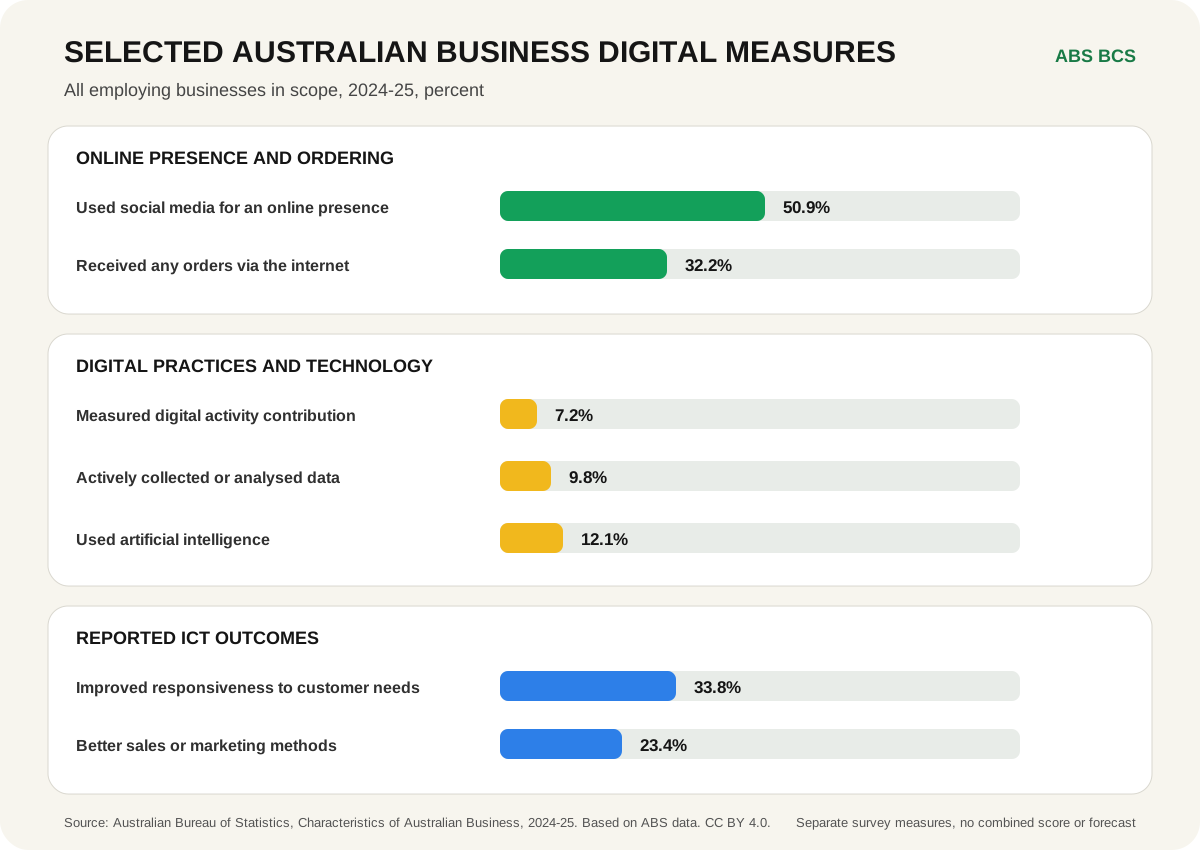
Source: Australian Bureau of Statistics, Characteristics of Australian Business, 2024-25. Based on ABS data under CC BY 4.0. Each bar is a separate survey measure. No combined score or forecast is shown.
Download accessible chart SVG| Measure | ABS workbook table | Percent |
|---|---|---|
| Online presence and ordering | ||
| Used social media for an online presence | Internet connectivity and activities, Table 3 | 50.9% |
| Received any orders via the internet | Internet connectivity and activities, Table 4 | 32.2% |
| Digital practices and technology | ||
| Measured the contribution of digital activities to business performance | Use of ICT, Table 1 | 7.2% |
| Actively collected or analysed data to make informed decisions | Use of ICT, Table 1 | 9.8% |
| Used artificial intelligence | Use of ICT, Table 2 | 12.1% |
| Reported ICT outcomes | ||
| Reported ICT was important for improved responsiveness to customer needs | Use of ICT, Table 3 | 33.8% |
| Reported ICT was important for better sales or marketing methods | Use of ICT, Table 3 | 23.4% |
Exact workbook estimates by employment size
Employment size is based on persons employed. Micro, small, medium and large are survey output categories, not measures of digital maturity. Values are published to one decimal percentage point.
| Measure | All employing businesses | Micro, 0 to 4 persons | Small, 5 to 19 persons | Medium, 20 to 199 persons | Large, 200 or more persons |
|---|---|---|---|---|---|
| Online presence and ordering | |||||
| Used social media for an online presence | 50.9% | 42.0% | 62.9% | 77.9% | 86.3% |
| Received any orders via the internet | 32.2% | 26.6% | 41.2% | 44.9% | 47.2% |
| Digital practices and technology | |||||
| Measured the contribution of digital activities to business performance | 7.2% | 4.9% | 9.6% | 15.8% | 32.6% |
| Actively collected or analysed data to make informed decisions | 9.8% | 5.8% | 13.7% | 26.1% | 52.9% |
| Used artificial intelligence | 12.1% | 10.7% | 12.3% | 22.3% | 34.7% |
| Reported ICT outcomes | |||||
| Reported ICT was important for improved responsiveness to customer needs | 33.8% | 28.1% | 40.8% | 52.7% | 63.8% |
| Reported ICT was important for better sales or marketing methods | 23.4% | 18.2% | 30.5% | 38.9% | 46.5% |
The all-business estimate is not an average of the four displayed employment-size percentages. The ABS survey weights observations to represent the in-scope business population.
Direct historical comparisons published by the ABS
These values reproduce the rounded whole percentages stated in the 2024-25 ABS release. They are presented separately from the exact workbook table and do not form an annual time series.
| Measure | 2021-22 | 2024-25 |
|---|---|---|
| Used social media for an online presence | 47% | 51% |
| Received any orders via the internet | 30% | 32% |
| Measured the contribution of digital activities to business performance | 3% | 7% |
| Actively collected or analysed data to make informed decisions | 24% | 10% |
| Used artificial intelligence | 1% | 12% |
| Reported ICT was important for improved responsiveness to customer needs | 31% | 34% |
| Reported ICT was important for better sales or marketing methods | 23% | 23% |
Comparison boundary: the ABS redesigned the survey into a biennial innovation and digital activity framework. The release directly publishes these two-point comparisons, but it does not provide an annual series for the intervening years.
Source and reuse record
The public CSV keeps exact workbook observations and rounded release comparisons as separate dataset identifiers. It also retains the population, precision, source and limitation fields beside every value.
Characteristics of Australian Business, 2024-25
- Population
- Employing businesses in the Australian economy, with ABS exclusions
- Reference period
- Year ended 30 June 2025 or as at 30 June 2025
- Release date
- 2026-06-25
- Extraction date
- 2026-08-30
- Limitations
- Estimates cover employing businesses in the ABS survey scope and are subject to sampling and non-sampling error. Workbook proportions are published to one decimal place. Commentary comparisons are rounded to whole percentages. Adoption and reported ICT outcomes do not prove business performance, search demand or SEO results.
Reuse and attribution boundary
- Licence
- Creative Commons Attribution 4.0 International
- Attribution
- Based on Australian Bureau of Statistics data.
- Excluded material
- The ABS logo, Commonwealth Coat of Arms, trade marks, microdata, third-party material and protected branding are excluded from the website licence.
The CSV contains ABS-derived observations and SEO Guys source metadata only. It does not redistribute survey forms, microdata, third-party material or protected branding.
Download normalized data CSVEditor and publisher reuse
Reuse a source-labelled graphic
Each SVG keeps its source, geography, reference period and material limitation visible. Copy the accessible HTML or download the original file, then check the report notes before publication.
Graphic 01
accessible 2024-25 digital measures chart SVG
Prefer a plain report citation?
Copy the report title, update date, page URL and source credit as one plain-text reference.
Use is optional. Editors may cite the original government source, change or remove the supplied link, and make their own attribution and link-treatment decisions. The copied code does not require a followed link or a keyword-rich anchor.
Start with the survey population and reference period
The ABS estimates cover employing businesses in the Australian economy, subject to listed institutional-sector and industry exclusions. They do not cover every ABN, every non-employing business or every organisation operating in Australia.
The 2024-25 data refer either to activity during the year ended 30 June 2025 or a position as at 30 June 2025. The online survey used a random sample of about 7,000 businesses, stratified by industry, employment size and a state-based indicator, and recorded an 87.9% response rate.
Workbook proportions are published to one decimal place. Commentary figures are rounded to whole percentages. The CSV identifies the precision and source boundary for every observation.
- State that the population is employing businesses in scope.
- Keep the 2024-25 reference period beside each estimate.
- Do not mix one-decimal workbook values with rounded commentary values without labelling precision.
- Retain the survey and sampling limitations when reusing the data.
Keep digital presence separate from online ordering
The workbook reports that 50.9% of employing businesses used social media for an online presence. A separate question reports that 32.2% received any orders via the internet. One measure describes a type of presence and the other describes a commitment to purchase through an online channel.
An internet order can be placed through a business website or app, a third-party platform, electronic data interchange or another online method. Payment does not need to be completed online. The measure does not attribute an order to organic search or another marketing channel.
Neither observation measures online revenue, retail turnover, share of sales, traffic, search visibility or conversion rate. The separate Australian online retail report covers a different ABS population and unit and must not be combined with these percentages.
Read measurement, active data use and AI as separate practices
The ABS workbook reports that 7.2% of employing businesses measured the contribution of digital activities to overall business performance. A separate 9.8% actively collected or analysed data to make informed decisions, while 12.1% reported using artificial intelligence.
These questions do not form a funnel. A business can report one practice without reporting another, and businesses could select more than one technology. The AI question measures whether the technology was used, not its intensity, purpose, quality or commercial effect.
Employment-size estimates provide useful context but do not diagnose one business. A measurement plan still needs business-specific goals, channel definitions, consent settings, analytics implementation and a documented decision process.
Reported ICT outcomes are not causal performance evidence
The survey asked businesses whether ICT use was important for specific outcomes. The workbook reports 33.8% for improved responsiveness to customer needs and 23.4% for better sales or marketing methods among all employing businesses in scope.
These are reported outcome categories from a business survey. They are not audited revenue changes, controlled experiments, channel attribution results or proof that one technology caused an improvement.
The figures should not be used as a benchmark for expected SEO, analytics, advertising or AI performance. They do not state the size, timing or financial value of an outcome.
Use only the historical comparisons published by the ABS
The ABS release directly compares these seven national measures with 2021-22 and publishes the comparison as rounded whole percentages. This resource reproduces those stated comparisons without calculating a longer series or interpolating the years between releases.
The Business Characteristics Survey was redesigned and recoupled into a biennial innovation and digital activity framework for 2024-25. The scheduled 2023-24 digital activity cycle did not proceed. Use the published comparisons as two reference points, not as an annual trend line.
Changes in survey content, reporting behaviour, sampling and the underlying business population can affect interpretation. The observations do not explain why a percentage changed.
What the dataset cannot prove about search
National adoption can frame a measurement discussion, but it cannot establish keyword demand, search intent, ranking feasibility, click-through rate, lead quality, customer value or the condition of one website.
It also cannot prove that digital adoption improved business performance or that SEO caused an observed outcome. Search decisions need Search Console, analytics, customer, sales, margin, capacity and result-page evidence tied to a clearly owned page.
This report makes no forecast or guarantee for rankings, traffic, enquiries, sales or revenue. A higher or lower adoption percentage is not evidence that an SEO investment will succeed or fail.
Download, cite and reuse the observations
The normalized CSV contains source-labelled workbook observations by employment size and a separate dataset for the whole-percentage comparisons published in the ABS release. Each row retains the population, measure group, unit, precision, source table, release date, extraction date, licence, attribution and limitations.
ABS website material is available under the Creative Commons Attribution 4.0 International licence except for listed exclusions. This resource uses statistical observations and source facts. It does not reproduce the ABS logo, Commonwealth Coat of Arms, microdata, survey forms, third-party content or protected branding.
When quoting an official value, cite the relevant ABS release or workbook. When using the normalized CSV or original SEO Guys chart, retain the ABS attribution and source fields, and do not imply that the ABS produced or endorsed this presentation.
- Retain the population, unit, precision and reference period.
- Identify whether the value came from an exact workbook table or rounded release commentary.
- Keep separate measures separate and do not calculate a combined digital score.
- Do not imply ABS endorsement of the adapted CSV or chart.
Sources and further reading
Primary and authoritative sources used to support the factual guidance in this resource.
- Source 01ABS Characteristics of Australian Business, 2024-25, opens in a new tabPrimary release for the digital activity commentary and directly published 2021-22 comparisons.
- Source 02ABS Characteristics of Australian Business methodology, opens in a new tabOfficial scope, exclusions, survey design, reference period, precision, statistical-unit and quality guidance.
- Source 03ABS Internet connectivity and activities workbook, opens in a new tabOfficial workbook for online presence and internet ordering observations by employment size.
- Source 04ABS Use of ICT workbook, opens in a new tabOfficial workbook for digital practices, AI use and reported ICT outcomes by employment size.
- Source 05ABS copyright and Creative Commons terms, opens in a new tabOfficial website reuse terms, exclusions and attribution requirements for ABS material.